Observe the system.
Find structure in sequential data, financial signals, and real-world telemetry.
A little atmosphere
Ambient sound is off.Applied AI researcher / builder
I’m Mithilesh Adhinarayanan.
I turn noisy observations into better decisions — then build the systems that make the decision useful.
CSE · AI & DS / SASTRA Hosur, India
01 observe → model → act ∞

How do you turn uncertainty into a better next move?
Financial time series, traffic queues, network threats, a scrambled cube. I’m drawn to problems where mathematics explains the structure, learning finds the signal, and engineering makes the answer usable.
At SASTRA, I work across AI research and end-to-end applications: from a first experiment to data pipelines, model backends, and the interface someone actually uses.
Find structure in sequential data, financial signals, and real-world telemetry.
Connect reinforcement learning, probability, and constraints to decisions.
Take models beyond notebooks into APIs, applications, and working systems.
Systems I’m building at the intersection of models, data, and people.
From fixed timers to a network that responds. Camera telemetry feeds DQN agents, emergency preemption, and dynamic routing — with a hard safety layer learned policies cannot override.
Problem: traffic demand changes faster than fixed signal schedules. Approach: per-intersection policies, a coordinator, telemetry contracts, and mandatory clearance constraints. Scope: an end-to-end simulated platform with documented camera and controller integration points; real-road validation is a separate step.
An offline-first drone and counter-drone training simulator with degraded sensors, explainable AI cues, transparent scoring, and after-action review.
Problem: training decisions should remain measurable when sensors are noisy or degraded. Approach: deterministic scenario packs, a browser radar console, a local classifier cue, and an end-of-run review. Scope: a synthetic training prototype for the SIH 2026 brief.
A voice note and a photo become a bilingual artisan catalog. Offline-first capture meets self-hosted speech, image, and language models.
Problem: catalog entry should not require typing or a reliable connection. Approach: a local draft queue, self-hosted inference, and structured catalog generation. Scope: a prototype; production authentication and live ONDC gateway publishing are ongoing work.
Before a model can make a good decision, its inputs need care. An agent chooses whether to accept, replace, or drop missing, spiking, or stale currency-feed observations.
Problem: corrupted ticks contaminate downstream quantitative models. Approach: explicit observation/action spaces and increasingly difficult remediation tasks. Scope: a simulated feed-remediation environment, distinct from the exchange-rate forecasting research below.
Event-based Fusion for Semantic Satellite Analytics and Transmission. Search observations in natural language, review ranked change events, compare evidence, and prepare compact semantic packets instead of repeatedly moving full-resolution imagery.
Problem: analysts should be able to find meaningful changes without repeatedly transferring entire image collections. Approach: natural-language search, a ranked change-event queue, an AOI evidence panel, and semantic packet preview. Scope: an offline-first prototype using synthetic demonstration data.
An end-to-end matching pipeline that turns messy business records into ranked candidate pairs: country-aware blocking, TF-IDF and token features, a gradient-boosted matcher, and a threshold tuned for the challenge objective.
Problem: the same entity can appear under different names, addresses, and source systems. Approach: reduce the search space with country and token-aware blocking, then score candidates with name, address, and country features. Scope: a challenge pipeline that writes the required candidate and matching outputs.
A Bayesian volatility proof of concept for EUR/USD returns. A latent Gaussian random walk tracks changing variance while Student-T observations accommodate heavy-tailed market shocks.
Problem: market returns do not have constant variance, especially during shocks. Approach: infer a latent volatility process with a Gaussian random walk and Student-T observation model, then inspect convergence and posterior behavior. Scope: a preparatory Bayesian time-series notebook for a PyMC-focused GSoC path.
Foundational models and notebooks. PyTorch, TensorFlow, and NPTEL coursework.
Bayesian modelling and open-source preparation. A learning and contribution track.
Data pipelines, model workflows, and application backends built end to end.
Browse the broader set of projects, experiments, and preparation tracks on GitHub.
A GSoC 2026 preparation project for Machine Learning for Science. The notebooks build deep-learning pipelines for calorimeter-shower classification with PyTorch CNNs, ROC-AUC evaluation, and SHAP heatmaps that make the model’s physical evidence inspectable.
Open repository ↗A FastAPI microservice proof of concept that ingests temporary road closures and changes graph edge weights so Dijkstra routing recalculates detours immediately, without rebuilding a full planetary index.
Open repository ↗A personal preparation repository for data structures, algorithms, Codeforces, competitive programming, puzzles, and the structured practice that supports quantitative and systems work.
Open repository ↗Two active directions at SASTRA: uncertainty in markets and long-running threats in networks.
Combining deep neural networks and PPO policy-gradient reinforcement learning with crude oil, gold futures, and NIFTY 50 as macroeconomic signals.
The research reports predictive accuracy above 95%. The paper is submitted to IEEE and awaiting peer review. This reported result needs to be read with the study’s metric, data split, and baseline; a public evaluation artifact is not linked here yet.
Investigating deep learning and anomaly detection to identify stages of sophisticated, long-term threat activity hidden in enterprise network traffic.
How can models connect subtle anomalies across network activity rather than treating every event in isolation? This is an ongoing research direction, with investigation focused on threat stages and persistent behavior.
A complete view of my working toolkit, organized around what it helps me build.
Learn a representation. Optimize a policy.
Reinforcement learning · deep learning · PPO · DQN · multi-agent RL · neural networks · policy gradients · backpropagation · transfer learning · time series · model optimization
Applied in Adaptive Traffic ↗Turn unstructured language into useful systems.
NLP · LLMs · Transformers · BERT / GPT architectures · text classification · sentiment analysis · tokenization · embeddings · prompt engineering · retrieval-augmented generation
Applied in CraftHaat ↗Pixels become observations, observations become action.
CNNs · object detection · image classification · image segmentation · feature extraction · real-time video processing · vehicle detection
Camera-to-policy telemetry ↗Express the idea. Understand the machinery.
Python (advanced) · Java / Swing / GUI · C++ · C · SQL · JavaScript · data structures and algorithms · competitive problem-solving
Explore code across the stack ↗Connect the model to the person using it.
Frontend and backend development · HTML / CSS · REST and WebSocket APIs · database integration · offline-first mobile workflows
Explore application work ↗Clean inputs. Better experiments.
Feature engineering · data cleaning · exploratory data analysis · statistical analysis · data visualization · financial and sequential data pipelines
The research notebook ↗Find a signal. Account for uncertainty.
WorldQuant BRAIN · custom expression languages · alpha research · algorithmic trading · backtesting · exchange-rate modelling · financial forecasting · macroeconomic analysis · risk analysis · portfolio optimization
WorldQuant research experience ↗Make experiments reproducible and systems connected.
High performance computing · Linux · Git / GitHub · Docker · Raspberry Pi · Redis · MQTT · Jupyter Notebook · Google Colab · VS Code · network security · APT detection · anomaly detection
From edge telemetry to APIs ↗Look for the invariant beneath the complexity.
Advanced mathematics · probability theory · linear algebra · calculus · statistical modelling · optimization · Olympiad mathematics · physics · proofs and problem-solving
Mathematics in public ↗Developing and backtesting quantitative alphas using probability and statistical modelling. Reached Gold Genius level while researching signal quality across global markets.
Conditional Consultant track / Apr–May 2026
Built and deployed machine-learning architectures for automation projects, connecting Python data pipelines, REST APIs, and model backends in an Agile development workflow.
Investigating APT detection since February and DNN–RL financial forecasting since March. Connecting anomaly detection, sequential learning, and decision-making.
Research directions ↗Delivering custom machine-learning solutions and full-stack applications: data pipelines, training workflows, and deployment-ready backend APIs.
Freelancer profile ↗Speedcubing is where state spaces become something you can hold. Patterns, constraints, algorithms — and the satisfaction of a better next move.
A small object with an enormous state space. Each legal turn changes the permutation; the challenge is choosing a useful sequence.
43,252,003,274,489,856,000 reachable states.
A visual playground for 2×2, 3×3, 4×4, 5×5, Pyraminx, and Clock. Official competition results are highlighted below.
B.Tech / Computer Science Engineering
Artificial Intelligence & Data Science
Thanjavur, Tamil Nadu
Financial Markets certification
Deep Learning coursework
Web Programming with Python & JavaScript
Contributing to Mathematics, Computer Science, and Physics communities on Stack Exchange. Sharing solutions and engaging with difficult technical questions.
Stack Exchange ↗Engaging with challenging mathematics and CS competition problems through Art of Problem Solving since 2022. A place to develop intuition, rigor, and better explanations.
Art of Problem Solving / 2022 → ongoingExperiments, research preparation, and working systems — the workbench keeps moving.
Current activity on GitHub ↗
Open GitHub profile ↗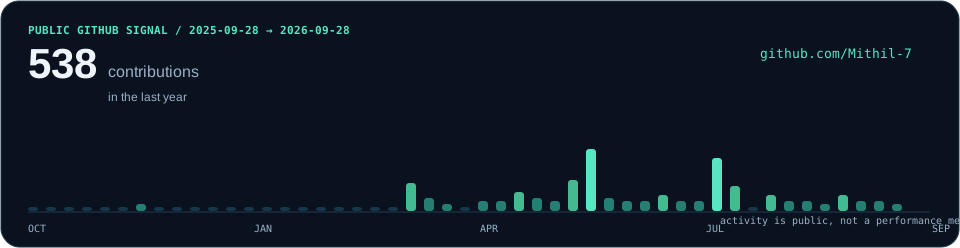
Research collaborations, internships, and freelance AI/ML work. Especially where learning systems meet financial data or real-world decisions.
mithilcuber@